On the third day of our trip, after we toured the Library of Congress, we visited the National Archives. We walked around the backside of the building, that faces away from the mall and sits along Pennsylvania Ave, because the Cherry Blossom Festival Parade was happening on the other side.
Over the first 150 years of its existence, the United States Government accumulated all of the documentation of its policies and decisions. It had no place to store these records. Therefore, in 1926 Congress approved the construction of the National Archives Building. Construction began with the groundbreaking in 1931, and in 1933 President Hoover laid the cornerstone. The building wasn't completely finished until 1935.

The architect John Russell Pope designed the building and intended it to be a temple of history. The building has a total of 72 columns, each 53 feet high and 5 feet 8 inches in diameter.

The research entrance is located on this side of the building.

To the left of the research entrance sits a giant female figure representing the Future.

Inscribed in the base of her pedestal are the words, "What is past is prologue."

The the right of the doors sits a large male figure that represents the Past.

Inscribed in the stone on he pedestal are the words, "Study the past."

We had reserved a timed entry slot a couple of months before our trip so that we were sure to get in. We walked around the side of the building to find the entrance for those with reservations. On the way we encountered the crowd waiting for the parade.

The line that we had to wait in ran parallel with Constitution Ave, the street that runs along the building's front. The parade was creeping down that street. We got to see some of it while we were in line. We couldn't have picked better seats for the parade if we had been trying to.

Although the parade wasn't that impressive, we only saw a few small balloon floats, some dancers and a band, it made our wait time pass quickly.

As we wound our way up to the doors, we got an up close view of the impressive columns.

After passing through security we headed towards the rotunda that houses the Charters of Freedom: the Bill of Rights, Declaration of Independence and Constitution. We had to wait in line for quite a while and were stuck behind two or three large, rowdy school groups. The waiting area and rotunda room were lit dimly to preserve the original (and very old) papers on display. While we were waiting, a security guard spoke to us about the papers we were about to see. He also told us that no photography was allowed because they didn't trust everyone to keep their camera's flash off. He was really funny and made sure that we all knew that the movie National Treasure was complete fiction in regards to the National Archives buildings and the documents we were about to see.
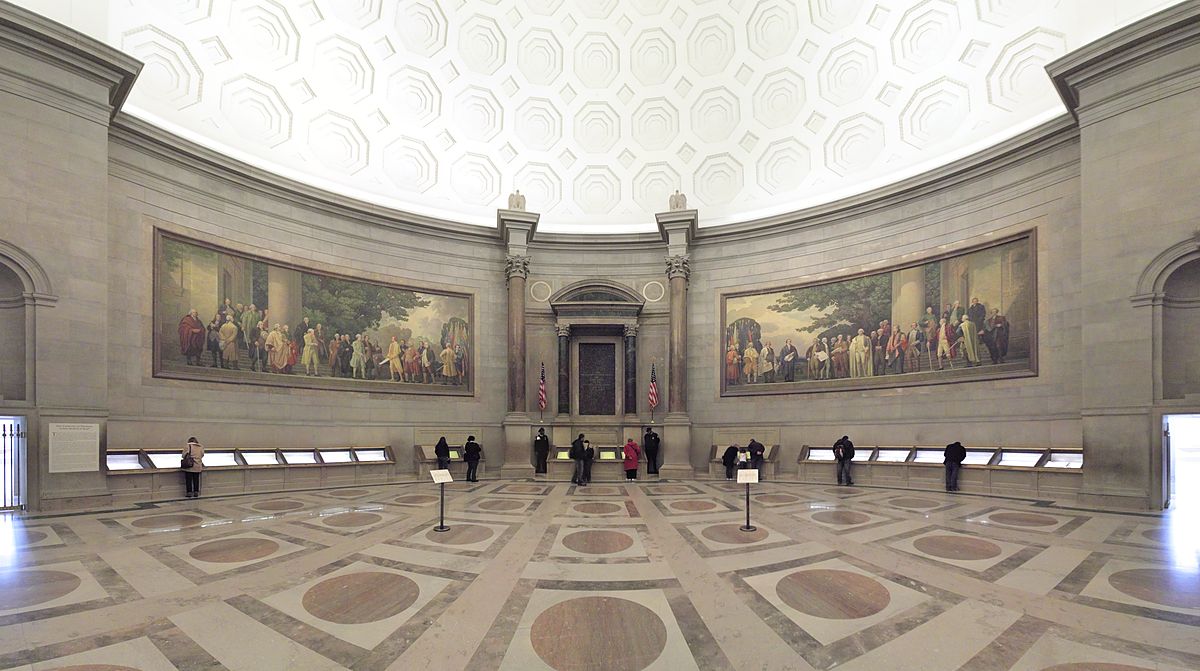
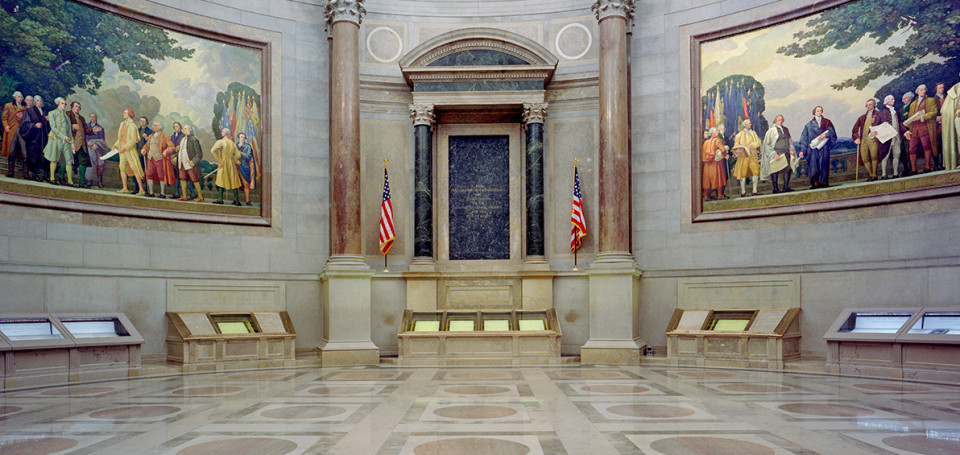
Finally they unhooked the velvet ropes and let us inside the rotunda. I found a couple pictures online to show you what it looks like. The actual room is almost dark, unlike the brightness in the pictures.
 |
| Source |
 |
| Source |
On either wall of the room sits a large mural. Both murals were painted by Barry Faulkner from 1934 to 1936. The left mural, titled The Declaration depicts Thomas Jefferson holding the Declaration of Independence. Behind him stand Benjamin Franklin, John Adams, Roger Sherman, and Robert Livingston as he talks to John Hancock about the document. If you want to know who the other men are, visit this link.

The mural on the right, titled The Constitution shows James Madison holding the Constitution and presenting it to George Washington. To identify the other men, visit this link.

We started looking at the display cases on the right-most side of the room, as it was the least crowded. The cases held many reproductions of documents, letters and drawings along with signs explaining the impact of the charters on the country through time. We then got to see one of the original 14 handwritten copies of the Bill of Rights. Another such copy is owned by the NY Public Library and we got to see that one last July. The writing was so faded that we had to lean down with our faces all but pressed against the glass to make out the words. It is in such poor condition because it was sent to one of the states and then passed around and displayed who knows where. It was still cool to be standing in front of it.
 |
| Source |
We then walked over to the display cases sitting on the left side of the room. These cases held copies of documents, letters, drawings and other items along with signs that described the making of the charters. We learned that Thomas Jefferson raised geese so that he would have a plentiful supply of fresh quills, as each goose only produced 10 to 12 good quills. We thought it was interesting that feathers from the goose's left wing made right handed quills and right wing feathers made left handed quills.
We then viewed the Declaration of Independence. It was very cool to be standing in front of a piece of history. The document was written out by Timothy Matlack, a clerk to the Second Continental Congress. It is almost in worse shape than the Bill of Rights. We got as close as possible to the glass and could barely see the words on the parchment. The signatures are basically invisible, although we could make out a faint "J" from John Hancock's signature. According to the archives website: "As the Continental Congress, during the years of the revolutionary war, scurried from town to town, the rolled-up Declaration was carried along. After the formation of the new government under the Constitution, the one-page Declaration, eminently suited for display purposes, graced the walls of various government buildings in Washington, exposing it to prolonged damaging sunlight. It was also subjected to the work of early calligraphers responding to a demand for reproductions of the revered document." One of the security guards told us that people used tape and paste to repair the document as it became worn. How crazy to think of slapping some tape on the Declaration of Independence.
 |
| Source |
It took us a little while to weasel our way in front of the cases holding the original U.S. Constitution. It was signed in 1787, making it 227 years old. This was an awesome experience. The document was hand written by Jacob Shallus, the assistant clerk of the Pennsylvania State Assembly. The writing was much more legible than the Declaration. We could clearly see the signatures of George Washington, Benjamin Franklin, James Madison and Alexander Hamilton along with the rest. The Constitution was kept in the government's custody and not put on public display; therefore, it remains in great condition today. As we were reading it, we saw places on the document where Shallus forgot to write a word and had to go back and add it. He added a "^" symbol in the spot where the missing word was to go then wrote the word above that symbol.
 |
| Source |
After we exited the rotunda we wandered through the public vaults for awhile. They had various documents, drawings, maps, letters and other items on display. The lights were much brighter in this section, letting us know that the documents we were seeing were not the originals. In this section, we found a facsimile of the Emancipation Proclamation signed by Abraham Lincoln. Even though it wasn't the original document, it was still neat to see.
 |
| Source |
We left soon after that. I just realized while writing this that we forgot to go see the Magna Carta while we were there. They have it on view just outside the rotunda. We came in through a side entrance, so we never really walked past it, and didn't even think about it while we were there. Oh blast! I guess we'll just have to see it next time, if we ever make it back to D.C. again.
The parade had ended by the time we exited the archives, and the crowds were gone. We took some time to look at the building's front entrance.


At the bottom of the steps to the left is a stone figure that represents Heritage.

The words on his stone pedestal read, "The heritage of the past is the seed that brings forth the harvest of the future."

Sitting on the right side of the steps sits another figure that represents Guardianship. The words inscribed on his pedestal are,"Eternal vigilance is the price of liberty."

Our time at the National Archives was a lot of fun. It's a beautiful building with some wonderful treasures inside.
We walked along the right wing of the building, where I sat down on the stone retaining wall running along the grass. Brian went and bought us hot dogs and drinks from the food cart across the sidewalk. The food was really good, especially the sauerkraut I kept stealing from Brian's hot dog. After eating, we went back and bought some ice cream for dessert. It was the perfect treat, because it had gotten nice and hot outside.

After our meal we headed over to the National Spy Museum, which you'll get to read about in our next post.

Very nice -- I'm sad you forgot to see the Magna Carta. Brian has seen a copy of the Magna Carta -- does he remember? It's a lot like viewing the Declaration and the other documents. However, because it was done on vellum instead of parchment, it has held up fairly well for how super old it is. At least you got to see a Gutenberg Bible and a hand-written one. Same sort of writing -- very pretty and super hard to decipher.
ReplyDeleteWait -- maybe vellum and parchment are the same thing. Vellum is made from a treated hide. Is the Declaration on a paper? I can't remember a dang thing.
ReplyDelete